As we enter week 5 of Distance Learning I can feel my energy wane and my momentum slow. It is now, at this time, that I revisit my routine. Searching for more efficient or effective ways to maintain my productivity. Emails, meetings and to-do lists have spiralled out of control whilst we pivot and learn how to respond to ever-changing government prevention regulations. The increased workload is felt by all, teachers, students and parents. Add the stresses of social isolation, forced online collaboration and dodgy internet and you have a recipe for burnout.
During my mornings, I make it a point to read. If only for 20 minutes. This is essential for my growth as a leader, but also for maintaining my own well-being. This week I am reading Alain De Botton’s ‘The School of Life: An Emotional Education.’ Within the pages of this book, De Botton discusses the importance of art, nature and kindness in contributing to a well-rounded and healthy life. He also discussed the importance and necessity of taking a time-out. During a busy day, we can often feel guilty for staring out of the window or randomly vacuuming the floor. We should not, however, feel guilty at all. It can serve as an essential part of the thinking process by offering a pressure-free moment to let our thoughts run wild and maybe, subside.
“I had a great day. The high point was staring out of the window.”
Alain De Botton
De Botton claims that the point of staring out of the window is not to find out what is going on outside. It is more of an exercise in discovering and making sense of what is already going on in our own minds. Starting out of the window offers us an opportunity to experience a sense of ‘purpose-free calm’. To be able to observe the scene and yet not be part of the scene. No need to respond. A form of strategic procrastination.
“Procrastination may be the enemy of productivity, but it can be a resource for creativity.”
Adam M. Grant
Adam Grant discussed the power of procrastination in his book ‘Originals: How Non-Conformists Move The World.’ The best ideas can often be developed and improved upon if left a while to sit after being formed. During this period of Distance Learning, I am finding that staring out of the window and removing myself from the online environment, if only for a few minutes is of the utmost importance when cultivating ideas, and essential for maintaining my overall sense of well-being.
After furiously replying to emails and back-to-back meetings with parents. I close the laptop and look into the distance. I am lucky that I have a view of Shenzhen Bay outside my window. The water is calming and I can ignore the frantic goings-on in the foreground. Twenty minutes later I often return to my project calmer than before with a newfound creative approach or solution. It is working for me. I encourage you to give it a try. Find a window near you, stare into the distance and take notice of your emotions afterwards. Encourage your students to do the same. I am sure they will feel and perform better for it.
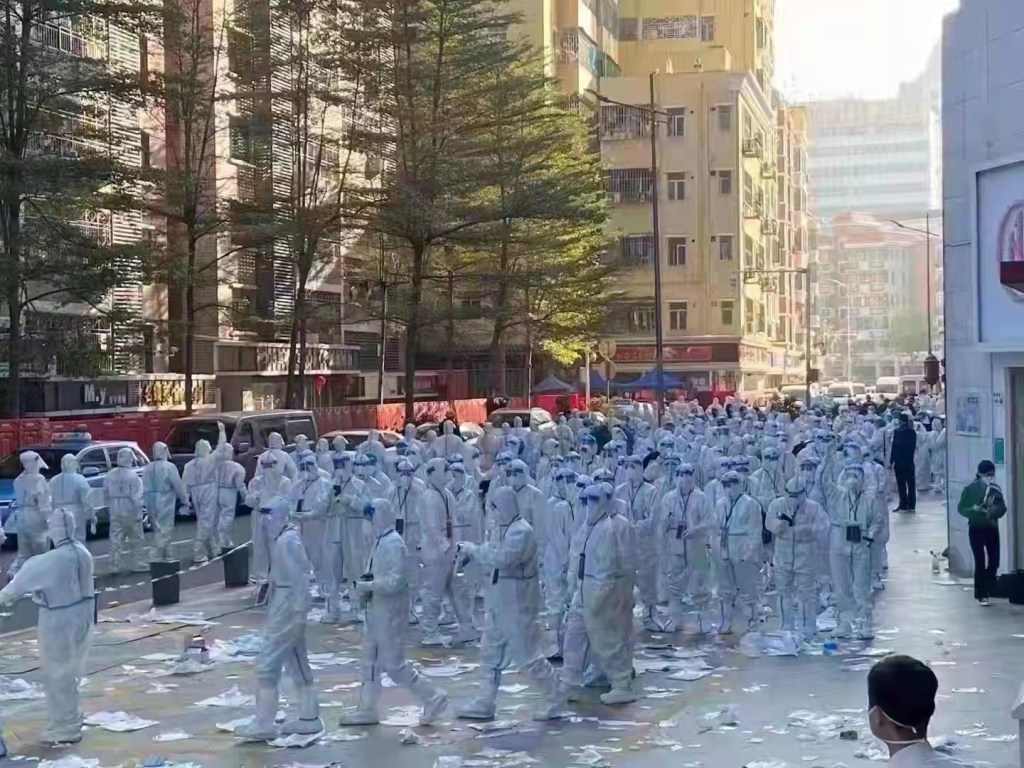
Last week, on Sunday 27th February, Shenzhen announced that they would be locking down areas of the city in order to prevent the spread of the Omicron COVID virus. I, like many of our school community, live in one of these areas and the thought of being quarantined, albeit at home, was not appealing. Whilst many countries have moved past these measures, in China, it is still very real.
You download the short video to see the testers marching through the streets.
We had heard of the lockdowns imposed in China. The duration is often extended without warning and the psychology of having the freedom to walk around freely weighs heavily on most people. Social Media plays a significant role in the spreading of rumour and fear but has also brought our local community together. Neighbours are talking online, sharing food when possible and offering much-needed support.
The same can be said of our school community. Teachers and students have shown great empathy and compassion towards each other and are ensuring that everybody feels connected and valued. Whether this has been teachers checking in with each other via WeChat or Wellness checks for students during lessons and Advisory, the effect is felt and appreciated.
As an Assistant Principal, I have the privilege of seeing the big picture. I am in the meetings, I am able to drop into online lessons and communicate with parents. The stress we are under is real. The love we are displaying towards each other is real too.
It occurred to me that at this time, each and every member of our community is forced to live by and consider, our school values of Respect, Perseverance, Creativity, Empathy, Integrity and Well-being. I have seen many examples throughout the week and appreciate the efforts people have made to continue life as ‘normal’.
Relationships know no hierarchy, but they know kindness and connection-especially when things are hard.
Dr. Jody Carrington
Respect
Respect has most frequently been expressed as patience. An understanding that we all interpret and respond to situations in different ways. Students may miss a deadline, but ‘was their WIFI not working or did they choose not to do it?’ How we respond as teachers to scenarios like this will impact the quality of our relationships with students in the future. Teachers know this and are working with care and sensitivity. Students are also understanding of the stresses faced by their teachers. Online lessons often take longer to prepare and require teachers to pivot and change the approach or medium by which they would deliver their lessons and assess students. Flipgrid, Kahoot, Quizlet are all being utilized readily along with many more innovative approaches to teaching.
Perseverance
We persevere because we must. As teachers, we know that students should not feel our burden and so we teach because that is what we do. I am reminded of Rita Pierson’s Ted Talk: Every Kid Needs a Champion. In times such as these, we do it for the kids, even if we do not much feel like it. Students persevere, but like us, they are tired. Preserving mental health has become more important than ever than delivering the curriculum. It always has been that way, but now we have a clear situation that we can all relate to that brings this message home.
Creativity
Engaging students, particularly, our younger students whilst online is increasingly difficult. Teachers are forced to flex their creative muscles to keep kids on board. Lessons are fun and kids are acknowledging this. On Thursday, I entered a Grade 6 English lesson. Students were randomly picked to give a 60 second Ted Talk focusing on the fun, crazy and positive aspects of their week. I was entered into the randomizer wheel and told my crazy tale of woe from Sunday morning. My shower door exploded whilst I was under the water. Glass flew down all around me and cut my arms and body. I was lucky it was not a lot worse. It was scary. Students were shocked, laughed, and appreciated an honest story from an adult at the school. This introduction was then sealed with a musical and fully enjoyable ‘Rick Roll’. Seeing all the students singing and dancing to Rick Astley made my day. Not only because they have a finer appreciation of cheesy music, but because it added some levity to the serious situation that we are all experiencing. The students know there is no end to this lockdown within sight, and so these moments of lift are valued more than ever.
Empathy
As a school, we have been working hard on developing empathy in our students. This is particularly important when working online as our sense of empathy diminishes. Students are more likely to consciously or unconsciously engage in cyberbullying, and reminding them to think from another perspective is key to building a sense of community. As a Leadership Team, we have sent individual messages to every teacher and contacted students that may be at risk. It has been a time-consuming process but the rewards have been worth it. We have been able to identify teachers and students in need and to support them accordingly. This is a simple human touch and goes a long way.
“Empathy is certainly harder to muster when you’re typing onto a screen instead of looking into someone’s eyes.”
Being locked down and out of sight has encouraged the need to place trust in each other. There is always an outlier, but for the most part, students are working diligently and honestly. We recently held our IBDP mock exams online. When invigilating through a webcam, it would be easy to think each sideways glance was an attempt to read notes posted on the wall. We were forced to trust our students and our own judgement. A somewhat stressful yet successful experience. Another COVID first for all involved.
Well-being
By utilising and living according to our values we have been able to preserve and monitor the well-being of the community. During these times it will fluctuate, but, knowledge is power, and by knowing how people are feeling we are able to respond and help as much as we can from within our homes. Whether it be informal wellness check-ins via Zoom, Flipgrid Olympics, or direct Well-being lessons, ensuring all of those in our care are flourishing is at the forefront of our minds.
It is in the minds of students too. One of our Grade 12 students asked if she could create a Padlet of positive messages to be placed on the Student Bulletin so that these can be read and shared during our Advisory periods. What a great idea! Another student has written an emotional account of her dealings with eating disorders and illustrated this with her own artwork. It is a powerful piece and goes live today in Wellbeing In International Schools Magazine. I encourage you to check it out.
These examples of how we live our values are celebrated in our school assemblies in the form of recognition cards. Teachers and students can write cards and the recipient gets a public shout out. Highlighting these positive behaviours go a long way in reinforcing the fact that without our well-being and the support from each other, we really cannot learn.
Leading Yourself
During Lockdown, my inbox has exploded and the tasks come in quicker than ever. It is easy to sit in front of a screen responding to the situation in front of you and not factor in any screen-free or relaxation time. I have made a point of reading, and in a time when teachers have felt a loss of purpose in their work I chose two books: Because Of a Teacher by George Couros and Leading with Purpose by Nick Craig. Both have been insightful, however, Because Of a Teacher is also a feel-good reminder of why we do what it is we do. The book is full of tales of teachers going the extra mile and making a difference. I highly recommend it. Reminding myself that now more than ever, our community needs its leaders healthy, caring and focused, keeps me on my game. I can put my frustrations aside and move onward. We are in it together.
During the last week, I have been humbled by our community response to the lockdown and whilst I cannot wait to return to face to face learning and see our students again, I am curious as to what other marvels may occur in the coming weeks.
As we enter into another round of COVID Testing and new government prevention measures I have been struck by the impact of uncertainty on my own wellbeing. The COVID landscape is constantly changing and the school response must adapt accordingly. The last-minute updates in protocol and policy inevitably take their toll as we aim to best serve the needs of the community whilst meeting the expectations placed upon us.
I have learned not to take these sometimes strange requests to heart and often enjoy a laugh about them with my colleagues. My sleep quality and energy levels however have told a different story. On some level, I had been responding or at worst reacting. My sleep had often been disturbed and my energy levels have been far lower than normal.
In a period of reflection I had realised that the routines that I held dear, that had fueled my performance, had been slipping. Journaling, reading, exercise and music were all taking a back seat whilst I had been focused on work. Needless to say, I felt that work was less enjoyable as a result.
In a conscious move to regain control over my own well-being. I began to prioritise my diet and sleep. I also started to re-build my routine and have thrown myself back into guitar drills and writing. The early nights and steamed salmon are paying off as my concentration at work improved.
I began to direct my attention to the secondary school well-being plan as this has been a focus for this academic year. In particular, “how will we ensure optimal well-being for our students?” and “how will we know our efforts are working?”
We have already introduced the Positive Education Enhanced Curriculum into our Advisory program and our next steps are to refine the delivery and assess the impact on our student’s well-being and character. In my research, I discovered the Flourishing at School platform. This SEL assessment software builds on the work of Martin Seligman and Geelong Grammar School and consists of the VIA Character Strengths Survey, a Student Flourishing Survey and a Daily Well-being Check-in. It perfectly meets our needs and allows us to monitor the development of individual students with regard to their character strengths and overall well-being. We are excited to enter the next stage of our well-being initiative and continue to improve our well-being curriculum.
This work has forced us to re-explore our graduate profile and our overall goals as a school. Our work with the Mastery Transcript Consortium also drives our efforts to build the competencies needed for employment in 2030 and informs much of our thinking. Whilst still very much in the planning stages, I know we are headed in the right direction and doing what is best for learning, and for our students. I will aim to keep writing updates relating to our well-being journey and sharing the resources that we have most beneficial along the way.
If you are engaged in a similar process, please take a look at the resources below. Enjoy.
In his thought-provoking book “Creating Cultures of Thinking”, Ron Ritchhart asks the question “What would you like the children you teach to be like as adults?” This simple question has a very deliberate purpose, to cause educators to reflect upon what they are teaching and in their role in shaping a student’s future. Typical answers to this question include creative, happy, resourceful, resilient, critical thinker and innovative. Teachers rarely say I’d like my students to be an A student or a 7. We forget the grades and focus on skill and character.
In the wake of COVID-19, skill and character development have become buzz terms, more so than before. The need to explicitly teach children the so-called ‘soft’ skills is crystal clear. Schools are responding in part, by realigning or developing their Social and Emotional curriculum. Programs such as SEE learning and the Positive Education Enhanced Curriculum (PEEC) are being discussed regularly in school meetings, at interviews and online. Such programs aim to support our children in their ability to thrive, flourish and be better versions of themselves. A lofty goal indeed.
“One of the most common responses from groups is that in a culture of thinking, there is a sense of purpose to the learning.”
Encouraging students and teachers to see past the grades, however, is no easy task. Especially, when university placements are dependent on them. It is a mindset shift and taps into the individuals own educational philosophies. It also forces schools to examine their own cultures and priorities. This will undoubtedly involve revisiting their own mission, vision and values. Take a walk around your school, look at the walls, listen to what is being said. Are you prioritising grades or are you focusing on developing thinking and wellbeing? Are the students being challenged? Are they excited to learn? Are they developing new passions?
“We don’t become better because we acquire new information. We become better because we acquire better loves. We don’t become what we know. Education is a process of love formation. When you go to a school, it should offer you new things to love.”
David Brooks: The Road to Character
A pet peeve of mine is the overuse of the word ‘summative’. During my career, I have heard students referring to their summative assessment with fear and reverence. Teachers often plan units with the end in mind, prioritising success on the final assignment over skill and character development. Does success on the assignment reflect skill development? More often than not, the answer is yes. Is this growth in skill and character explicitly communicated to the student? Often the answer is no. This is an understandable omission, but how do we make the shift from a culture centred upon exam success to one committed to developing well-rounded and happy individuals?
This year we have attempted to start the culture shift. We have introduced the Positive Education Enhanced Curriculum (PEEC) and incorporated their lessons into our advisory framework. Moving the focus of our energies to value and character development. It is a long road, but one we are willing to travel. We know it is the right thing to do for our students and so we persevere.
As we tap into the world of Social and Emotional Learning and consider how best to implement the program; it stands to reason that we re-examine our values, our priorities and our way of doing things. This helps to form new goals and a new way of seeing things. How we measure the success of our advisory program is now being considered and we have had recent conversations with The Mastery Transcript Consortium, a non-profit organisation committed to providing an alternative method of measuring student success. One that focuses on skill and character development over passing the test. We are new to the conversation and I look forward to seeing where it will take us. Being able to clearly see the impact of our efforts will be rewarding and powerful and provide a great deal of motivation to both teacher and student.
The importance of tapping into student passion and interest whilst providing them with ‘essential’ worldly knowledge has again made itself known. If a student is not interested or engaged they will not learn. Whether a school focuses on succeeding on a test or on skill development is irrelevant. The learning process must inspire and generate ideas and curiosity. The path to mastery requires that students want to learn, that they enter a flow state and lose themselves in the process. And so whilst, I lose myself in the research process, I hope that our teachers lose themselves in the process of planning and delivering life-worthy learning.
This week I decided to wake and go to school earlier than normal. An attempt to re-focus, recharge and find my usual routine. The demands of the job can creep up on you. The semester progresses quickly. The days increase in pace. Before you know it, you are on autopilot and responding rather than adapting. It is important to take stock and mix things up. Stay fresh and sharpen the saw.
Each morning I bought my usual coffee from the school cafe and sat myself down in an area that I rarely have time to go. The benches beside the sports field. Now the hot season is over, the temperature is perfect and I could hear the birds singing in the trees. I noticed that the benches had bronze placks on them and quotes about friendship. They had been donated by Grade 2 students. The first bench said:
The only way to have a friend is to be one.
Ralph Waldo Emerson
I began to think of my friends back home, and also of the friendships around our school community. Teachers friendships, student friendships and parent relationships. As my mind wandered a group of students began their running practice. I watched them as they were drilled by their teacher. Each student was supported by the others and enjoyed the early morning dopamine hit. I noticed how their feet shuffled as they gained pace, and how this was not one student but all of them. I then realised I had not noticed that about runners before. Do they all do it, or is it a product of learning? Will the shuffle disappear as their technique improves? Let the Youtube journey begin.
As Leonardo Da Vinci used to write lists of questions he pondered, I have begun to do the same. An attempt to create the curiosity I see in our students. Just questions, I do not know the answers. I have found this has a calming effect and is also making me a better leader. Listen first to understand and then to be understood.
This has shaped the way I have been approaching all of my conversations. Yesterday, I had many interesting conversations. For the most part, I just listened. I had an enlightening conversation around Diversity Equity and Inclusion with one of our teachers. His perspective surprised me. I listened and said little. I knew instantly I have a lot of learning to do around this topic and that I would learn a lot from listening to his perspective and the importance of being able to draw on his insight as we move forward in becoming a more inclusive school.
Fairness. I then had a conversation around fairness with Grade 6 student who is triggered when he perceives his teachers actions as unfair. Having recently completed the VIA Character Strengths survey I know this is one of my strengths. A sense of fairness and equity. I wondered if his teachers would also view this boys trait in a positive way. How could they use this very strong sense of right and wrong to help him learn? A topic for an upcoming Professional Learning Session.
When I reflect on the last day of the week, and the interactions I have had, I notice how many of them were directly related to our school values of empathy, integrity and wellbeing. Evidence that we are in fact living our school values. We do not need big initiatives to demonstrate that we are living our mission, we just need to take note of the small things that make up our day-to-day.
Benching myself every morning and taking twenty minutes to consider the learning that has been taking place in our school has given me a greater appreciation of what we do as educators on a daily basis. It has helped me to appreciate that whilst we may have a long way to go, we are indeed already well on the way to our goal of inspiring global minds.
Challenge yourself to take twenty minutes each day to reflect and consider the good work that we do. As human’s we can be drawn to the negatives, however, focusing on the positives helps us to succeed and improves our overall sense of wellbeing (Seligman). As our advisory program takes shape, I hope to see more and more of our community adopting a strengths-based approach in their lives and learning. After all, we all have something to share and this will only be enhanced when we are working to our strengths.